SHORT ANSWER
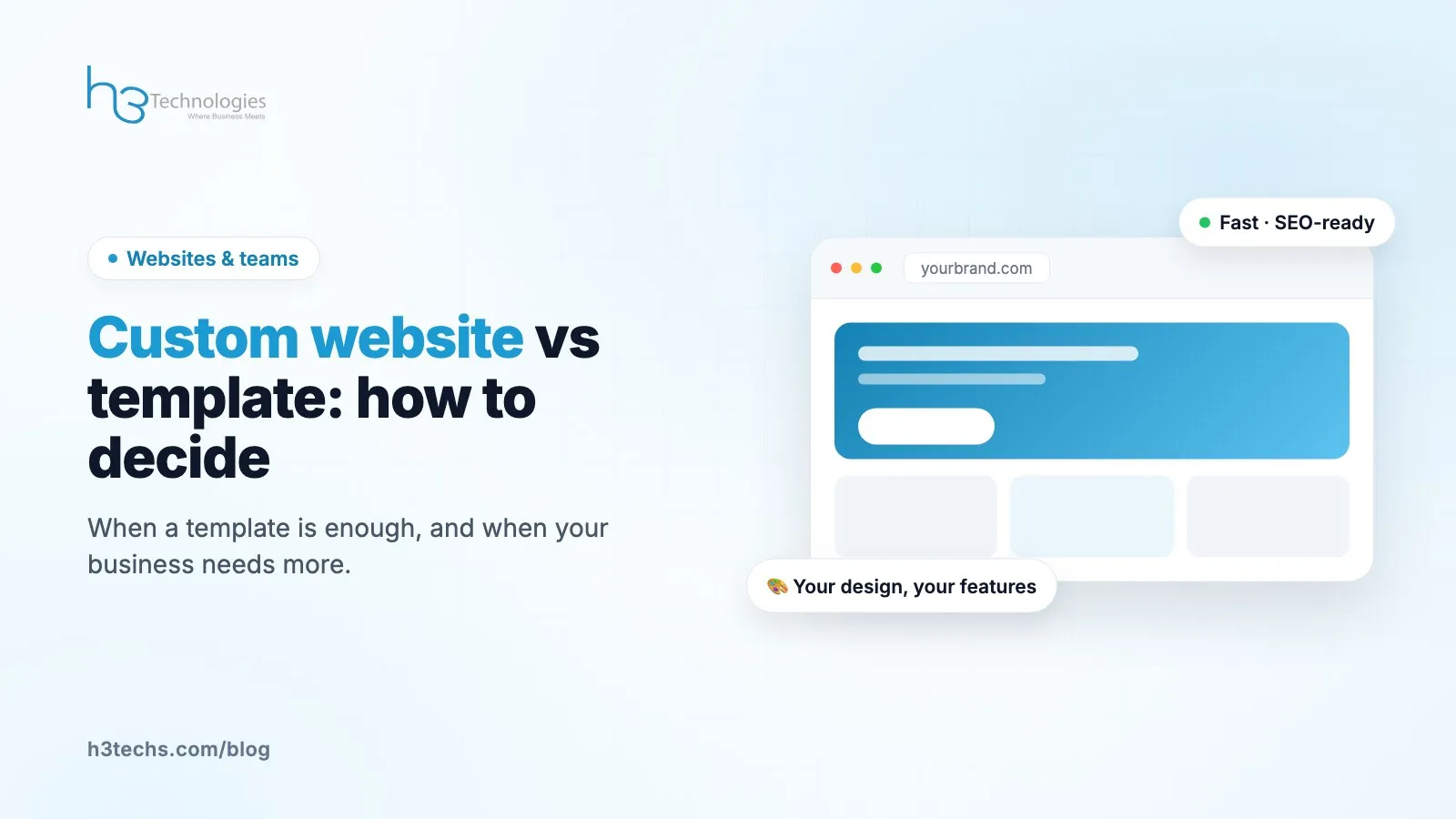
A template site is fine when you need something online fast, your needs are simple and your budget is small. A custom site is worth it when your website has to win business: it needs to load fast, rank on Google, explain what makes you different and turn visitors into enquiries. If your website brings in a real share of your customers, custom usually pays back.
Every week someone asks us some version of this: "Why would I pay for a custom website when I can buy a template for a few dollars?"
It is a fair question. Sometimes a template is the right call, and we tell people that. This guide is about how to tell which one you need.
In this guide
- When a template is enough
- When custom is worth it
- The costs people forget
- The middle option
- Three quick examples
- Questions to ask whoever builds it
- Questions we get asked
When a template is enough
Go with a template if most of these are true:
- You are just starting and need to be online this week.
- Your site is mostly a digital business card: who you are, what you do, how to reach you.
- Most of your customers come from referrals, not Google.
- Your budget is very tight right now.
There is no shame in this. A clean template site is far better than no site. You can always rebuild later when the business grows.
When custom is worth it
A custom site starts to make sense when your website is part of how you win work, not just proof that you exist.
- You want to rank on Google. Templates often carry heavy code and page builders that slow the site down. Speed and clean structure matter for search.
- Your offer needs explaining. If what you sell is not simple, a template's fixed layout forces your message into boxes that do not fit.
- You need specific features: a booking flow, a quote calculator, a client portal, or a connection to your CRM.
- You sell in more than one country or language and need each version set up properly for search.
- Your brand needs to stand apart. Popular templates show up on hundreds of sites. Visitors notice.
The costs people forget
The template price is rarely the real cost. A few things that add up:
- Plugins. To make a template do what you need, you often stack plugins. Each one can slow the site and needs updates.
- Your time. Someone has to fill in the template, write the copy and fix the layout when it breaks on mobile.
- The rebuild. Many businesses outgrow a template within a couple of years and pay for a second site anyway.
On the other side, custom has its own risk: paying for features you do not need. A good team should talk you out of things as often as they suggest them.
The middle option
It is not always one or the other. Two middle paths work well:
- Custom design, standard platform. A site designed for your business but built on WordPress, so your team can still edit pages easily.
- Start with key pages. Build the home page, main service pages and contact page properly. Add the rest over time.
When we build custom websites, we pick the platform around your team. If you want to edit everything yourself, that usually means WordPress. If speed matters most and changes are rare, a lighter setup like Astro can be a better fit.
Three quick examples
Real cases make this easier. Here are three we see often.
A new consultancy with two partners. They need a clean site with their services, a short bio and a contact form. Most work comes from people they already know. A good template, set up carefully, is the right call. Spend the money on a good photographer and good copy instead.
A clinic with three branches. Patients search Google for the treatment and the area. The clinic needs a page per treatment and per branch, fast loading on phones, and an easy way to book. This is where a custom site pays back, because each of those pages can bring in patients on its own.
A manufacturer selling to other businesses abroad. Buyers want to see the range, the quality checks and proof that the company is real. They may read the site in more than one language. A template forces all of that into a generic layout. Custom lets the site work like a good salesperson.
Questions to ask whoever builds it
- Will I be able to edit the text and images myself?
- How fast will the site load on a phone?
- What happens to my current Google rankings if you rebuild?
- Who owns the design, the code and the domain at the end?
- What does looking after the site cost each month, if anything?
If the answers are vague, keep looking. These are basic questions and a good team will answer them plainly.
Questions we get asked
How long does a custom website take?
A typical business website takes 3 to 6 weeks from approved design to launch. Bigger sites with custom features take longer.
Will I lose my Google traffic if I redesign?
Not if it is done carefully. Keep your page addresses where possible, redirect the ones that change, and check search console after launch.
Can you improve my current site instead?
Often, yes. If the design is fine but the site is slow or hard to use, fixing it can be cheaper than a full rebuild. We will tell you which makes more sense.
Not sure which one you need?
Send us your current site, or tell us what you are planning. We will give you an honest view, even if that view is "use a template for now". See custom website design or talk to us.