SHORT ANSWER
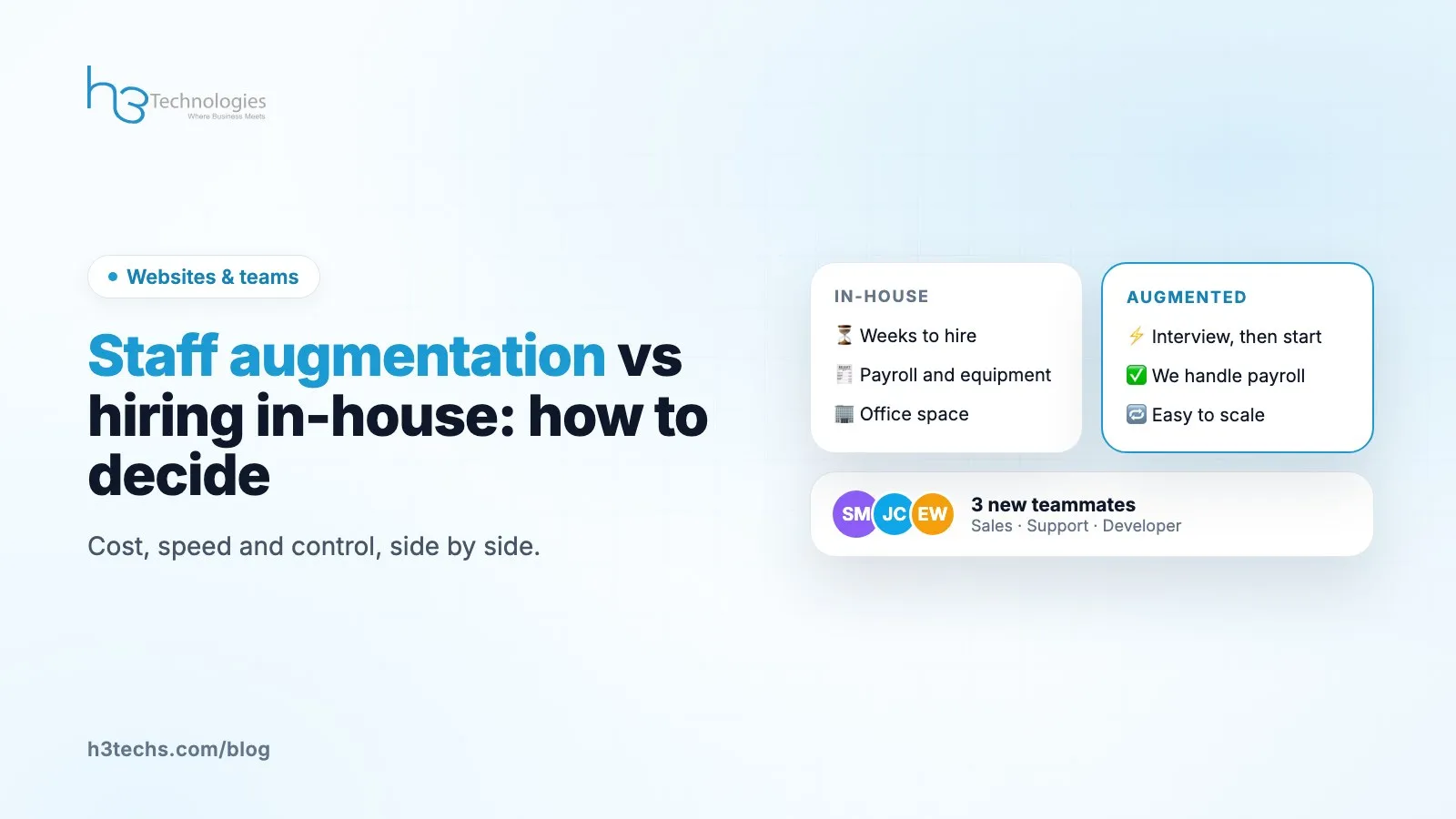
Hire in-house when the role is core to your business and you need it for years. Use staff augmentation when you need skilled people quickly, for a project or a busy stretch, or when hiring locally is slow or expensive. Many teams do both: a small in-house core, with augmented people added and removed as the work changes.
We get asked this a lot, usually by a founder or manager who has just lost three months trying to hire one developer, or one good support person, and still has nobody.
There is no single right answer. But there are some honest questions that make the choice much easier. This guide goes through them.
In this guide
- What staff augmentation actually means
- When hiring in-house is the better choice
- When augmentation is the better choice
- It is not just developers
- How to make it work day to day
- Comparing the real cost
- Questions we get asked
What staff augmentation actually means
With staff augmentation, a company like ours finds the person, employs them, pays them and gives them equipment. They work full time on your team. They join your meetings, use your tools and take direction from you.
That is different from a project, where the agency owns the result and runs the work. With augmentation, you run the work. The people are just not on your payroll.
When hiring in-house is the better choice
Be honest about this. Augmentation is not always the answer.
- The role is the heart of your business. If your product is software, your lead engineer should probably be your own employee.
- You need someone for many years and the local market has good people at a cost you can manage.
- The role needs deep internal knowledge that takes a long time to learn, and you cannot afford to lose it.
In those cases, take the time to hire well. It is worth it.
When augmentation is the better choice
- You need someone this month, not next quarter. Hiring a good person locally can take months once you count job posts, interviews and notice periods.
- The work goes up and down. A busy season, a launch, a big migration. You need more hands for a while, then fewer.
- Local hiring is too expensive for the role, or the skill is hard to find where you are.
- You do not want to handle HR, payroll and equipment for one or two extra people.
A pattern we see work well: keep a small in-house team that owns the important decisions, and add augmented people around them. When the busy stretch ends, you scale down without layoffs.
It is not just developers
People often think of augmentation as "renting a developer". In practice, the roles we place are much wider than that:
- Sales executives who follow up leads, run demos and close deals.
- Tech support staff who answer tickets and fix customer issues.
- Customer support agents for chat, email, WhatsApp and calls.
- Designers for brand, social media and product screens.
- Digital marketers for SEO, Google Ads and Meta Ads.
- Developers for websites, Shopify, mobile apps and web apps.
Support and sales roles are often the easiest wins. They are clear to measure, and a good person makes a difference in the first week.
How to make it work day to day
Most of the problems we have seen with augmentation are not about skill. They are about how the person is brought into the team.
- Interview them yourself. You should meet the people before they start. At H3 we share profiles and you choose.
- Treat them as part of the team. Same meetings, same chat channels, same updates. People who are left out do worse work.
- Give a clear first month. What should they own by week four? Write it down.
- Talk about fit early. If someone is not right, say so in the first few weeks. A good provider will replace them.
Comparing the real cost
When people compare the two, they usually put a salary next to a monthly fee and stop there. That leaves a lot out.
For an in-house hire, add up the time spent writing the job post, screening CVs and interviewing. Add the weeks or months the seat sits empty. Then add equipment, software licences, office space, leave cover and, if it does not work out, the cost of starting again.
For augmentation, the monthly fee usually covers the person, their equipment and the hiring work. What you still spend is your own time: onboarding them, giving them direction and reviewing their work. Do not skip that part. An augmented person with no manager does no better than an employee with no manager.
Neither option is cheap if the person is wrong for the job. The cheapest choice is whichever gets you the right person fastest.
Questions we get asked
Can I interview people before they join?
Yes. We share profiles that match your needs and you interview them before anyone starts.
Who manages them day to day?
You do. They report to you and follow your process. We handle hiring, payroll and equipment in the background.
What if someone is not a good fit?
Tell us early. We will find a replacement.
Can I start with one person?
Yes. Many of our clients start with one role, see how it works, then add more.
Need people on your team soon?
Tell us the role and the skills you need. We will send matching profiles. See staff augmentation or talk to us.