

SHORT ANSWER
A custom Shopify app costs more than an App Store app, and the price depends on what it does:
- A small app that does one job costs the least
- Admin screens, integrations and checkout changes add to the cost
- Plan for small running costs too: a server, updates and support
- Check the App Store first. If an app already does the job, you may not need a custom one
Your store has grown and the apps you use no longer fit how you work. Maybe you need Shopify to talk to your warehouse, or you want a feature no app offers. A custom app can fix that. The first question is always the same: how much will it cost?
This guide explains what decides the price, what you pay after launch, and how to get a fair quote. We build Shopify apps every day, so the examples come from our own work.
What is a custom Shopify app?
A custom app is built for one store or one brand. It is not listed on the Shopify App Store, and other merchants can't install it. It does exactly what your business needs and nothing else.
Stores usually build one to:
- Automate daily work, such as tagging, routing or splitting orders.
- Connect Shopify to other systems, such as an ERP, warehouse, courier or accounting tool.
- Add a feature to the store, such as a product builder or a special discount rule.
- Give the team its own tools, such as an admin page or a report Shopify does not have.
Do you need a custom app?
Often you don't. There are thousands of apps on the Shopify App Store, and many cost a few dollars a month. Before you pay for a custom build, check if one already does the job.
| Situation | Best choice |
|---|---|
| An App Store app does what you need | Use the App Store app. It is cheaper and ready today. |
| You need 3 or 4 apps stuck together to do one job | Consider a custom app. One app is simpler and can cost less over time. |
| Shopify must talk to your own system (ERP, warehouse, courier) | Custom app. Public apps rarely fit your exact system. |
| You want a feature no app offers | Custom app. |
| You want to sell the app to other merchants | A public app, built for the App Store. See Shopify app development. |
What decides the cost of a custom Shopify app
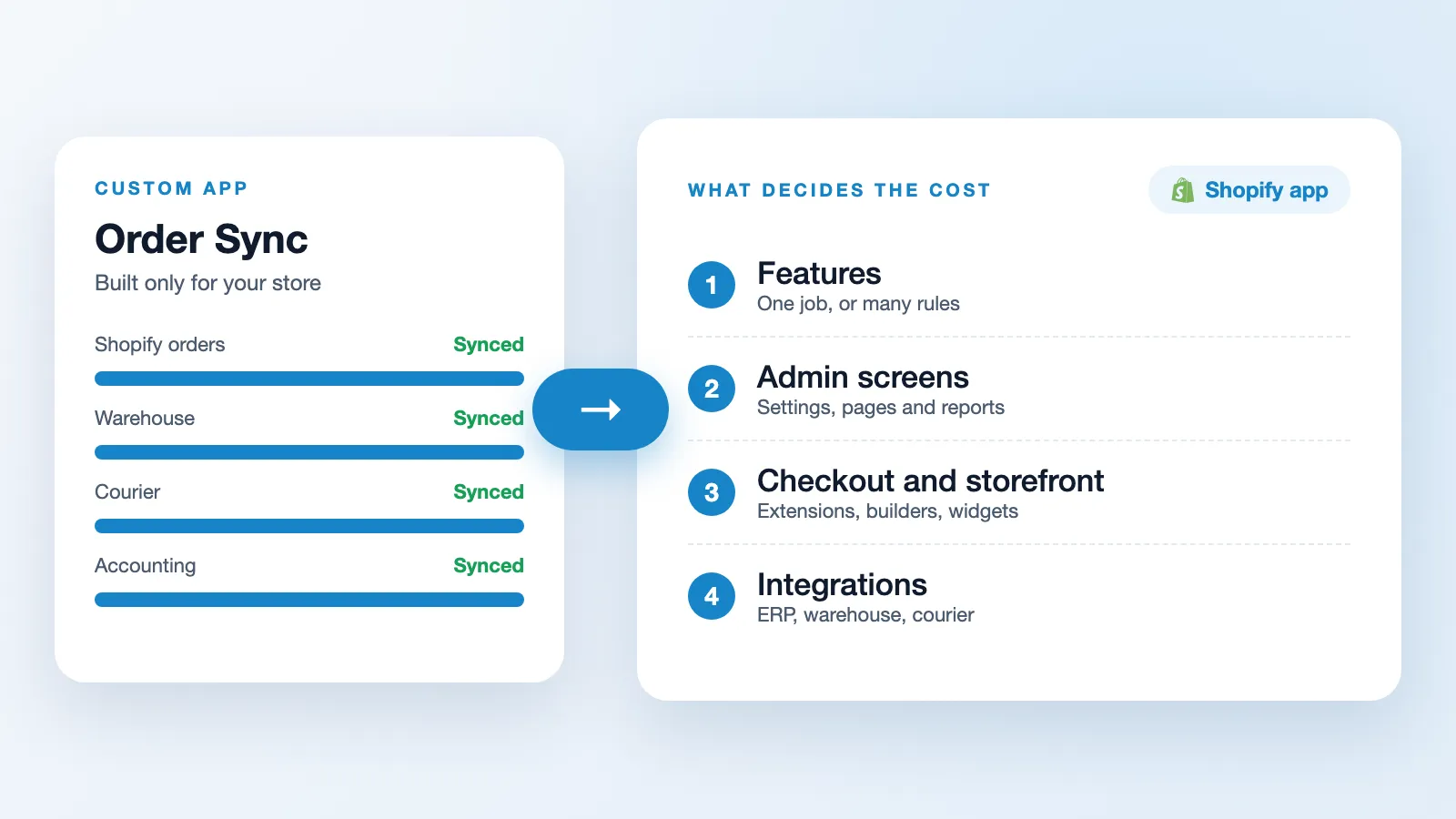
Every custom app is different, so nobody can give an honest price without knowing what it does. These are the things that move the price up or down.
| Cost factor | Lower cost | Higher cost |
|---|---|---|
| What the app does | One clear job | Many features and rules |
| Screens | Runs in the background, no screens | Its own admin pages, settings and reports |
| Storefront | Nothing shoppers see | A builder or widget on product pages |
| Checkout | No checkout changes | Checkout extensions or Shopify Functions |
| Integrations | None, or one system with a good API | Several systems, or an old system with no API |
| Data | A few orders a day | Thousands of orders, syncs in real time |
| Design | Shopify's standard admin look | Custom design on the storefront |
The biggest one is usually integrations. Connecting Shopify to a modern system with good documentation is quick. Connecting it to an old system with no API, or one that only sends files, takes much longer, because the developer has to work around it and test every case.
Two real examples
A bracelet builder for a jewelry store
EarthySoul Elements, a US crystal jewelry store, wanted shoppers to design their own bracelet bead by bead. No App Store app did this the way they needed. We built a custom builder on the product page, plus a "Build Your Stack" feature for up to five bracelets, then redesigned the whole store.
This is a higher cost app: shoppers use it on the storefront, it needs a custom design, and every bead choice has to flow into the cart correctly. Read the bracelet builder case study.
Order notifications for a fashion marketplace
LAAM, a fashion marketplace with many daily orders, needed customers to hear about their order at every step. We built a Shopify app around LAAM's own order flow, so updates go out on their own as each order moves forward. We have supported and improved it for more than four years.
This app mostly runs in the background. The work is in the rules: which update goes out, when, and what happens when an order changes. Read the LAAM case study.
What you pay after launch
The build is the big cost, but a custom app also has small running costs. Ask about them before you start.
- Hosting. The app runs on a server, which has a monthly cost. Small apps need very little.
- API updates. Shopify releases a new API version every three months, and each version is supported for at least 12 months. Your app needs to be updated before its version expires, or parts of it can stop working. See Shopify's API versioning.
- Support and changes. As your store grows you will want new features. Many stores keep a small monthly support plan.
Good news: Shopify charges no fee for a custom app built only for your store. Revenue share only applies to public apps sold on the App Store.
Do you need Shopify Plus?
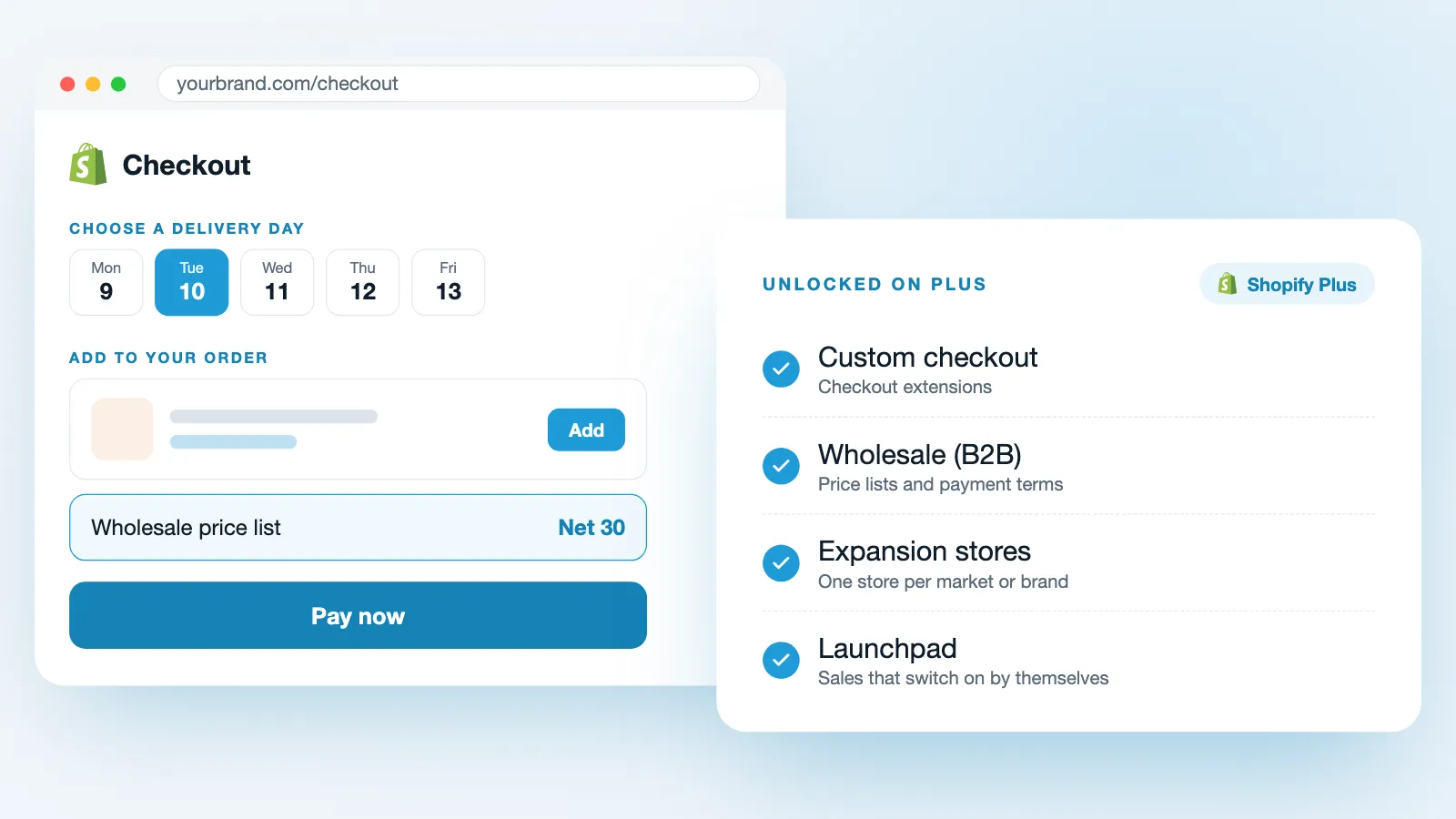
No. Custom apps work on every Shopify plan. A few features need Plus:
- Custom apps that use Shopify Functions, for example your own discount or delivery rules.
- Checkout changes on the information, shipping and payment steps.
Changes on the thank you and order status pages work on every plan. Not sure which plan you need? Read Shopify vs Shopify Plus.
How to get a fair quote
- Write down what the app must do, step by step, as if you were explaining it to a new staff member.
- List every system it must connect to, and ask those companies for their API documents.
- Split must-haves from nice-to-haves. Build the must-haves first and add the rest later.
- Ask for a fixed price for that written list, not an open hourly bill.
- Ask about running costs: hosting, API updates and support.
- Make sure you own it. You should get the source code and full access to the app and its server.
- Check the developer's past apps. Have they built Shopify apps before, and can you see them?
Hiring for the first time? Read how to hire a Shopify expert.
4 mistakes that make custom apps cost more
- Starting without a clear feature list, so the app changes again and again during the build.
- Building everything at once instead of the must-haves first.
- Forgetting the other system's side. If the ERP or courier has no API, the build gets harder and slower.
- No plan for updates, so the app breaks when its API version expires.
Need a custom Shopify app?
H3 Technologies is a Shopify Select Partner with 25+ of our own apps on the Shopify App Store, 4 of them Built for Shopify. Tell us what your app must do and we will send a fixed quote, with running costs included. Get a free custom app quote.
Frequently asked questions
How much does a custom Shopify app cost?
It depends on what the app does. A small app that does one job, like tagging orders or sending them to one other system, costs the least. Apps with their own admin screens, several integrations or checkout changes cost more. Ask for a fixed quote based on a written list of features.
Is a custom app better than an App Store app?
Not always. If an App Store app already does what you need, it is usually cheaper and faster. A custom app makes sense when no app fits your workflow, when you would need three or four apps to do one job, or when you need to connect Shopify to your own systems.
Are there monthly costs after the app is built?
Usually yes, but they are small next to the build. The app needs a server to run on, and it needs updates when Shopify releases new API versions. Many stores also keep a small support plan for fixes and new features.
How long does it take to build a custom Shopify app?
A small app can be ready in a few weeks. A larger app with admin screens and integrations takes longer. A clear feature list at the start is the best way to keep the time short.
Do I need Shopify Plus for a custom app?
No. Custom apps work on every Shopify plan. Some features need Plus, such as custom apps that use Shopify Functions and checkout changes on the information, shipping and payment steps.
Who owns the app when it is finished?
Agree on this before you start. You should get the source code and full access to the app and its server, so you are never locked in to one developer.